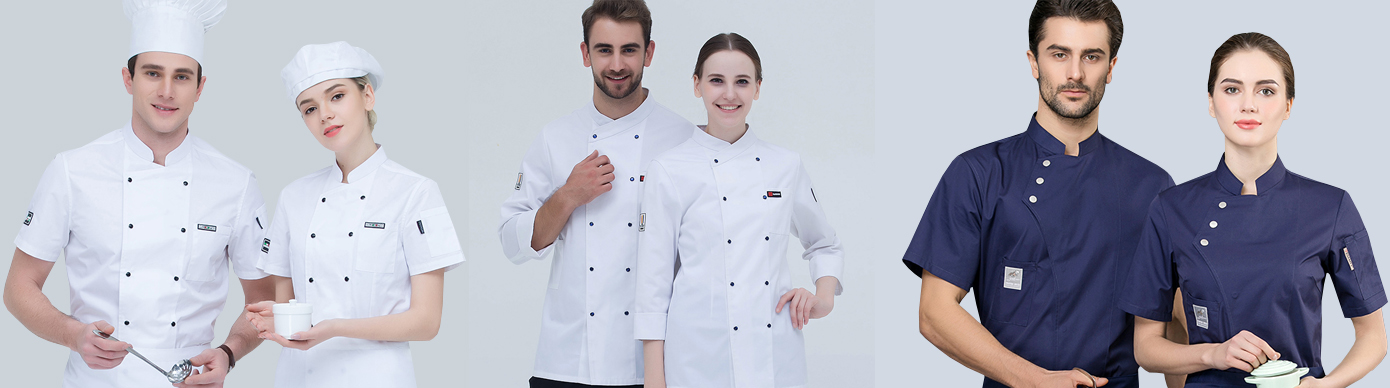
Heyday Dynasty makes chef uniforms for restaurant groups, hotel kitchens and uniform distributors. Coats, pants, aprons and hats — cut from your chosen fabric, to your size chart, under your label.
Fabrics are poly-cotton twill, 100% cotton and stain-resistant canvas — we send swatches before you decide.
Trims: stand-up or mandarin collar, double-breasted front, mesh back yoke, your own buttons and piping. Branding: woven label, printed chest logo, embroidered name — your label, not ours. Samples are charged at cost and refunded on your bulk order; send a style reference and your quantity, and we will quote within 24 hours.
Chef uniforms are different from other uniforms. Chef uniforms are unique compared to other uniforms as they require a special design to protect chefs from high-temperature oil, burning flames, and hot environments while providing the best comfort. In this article, we will discuss the special requirements for chef uniforms and how to customize them.
What are the special requirements for chef uniform style and design?
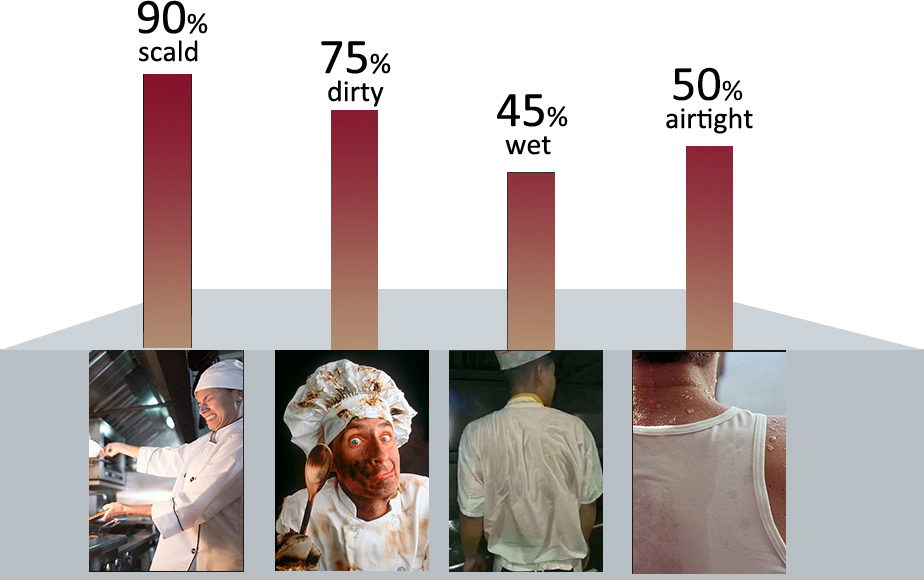
How to let the kitchen staffs protect themselves and have the best comfort in kitchen environment? This determines the design and style of our chefs clothing Ideas.
Collar shape: as we have seen, most chef uniforms use stand-up collars. On the one hand, the stand-up collar can protect the neck from being burned by oil. On the other hand, the stand-up collar gives the neck heat dissipation space and enough free space.
Center front design: during cooking the oil is easily burned and Splash. in order to avoid damage from high oil temperature and heat, The center front part need to be wider and thicker, so most chef jackets are design to double breast style, this way can make it thicker enough to Resist high temperature oil and a certain degree of flame burning. In addition, use double-breasted buttons or zippers to fix it up and down to firmly protect the chef’s body and avoid being burned during the cooking process.
Sleeves: For head chefs, we generally don’t recommend short sleeves. Choose a sleeve length of 3/4 sleeve or more like full length. if the working environment does not have high temperature oil or obvious flames, you can freely choose any kind. You can choose sleeveless chef coats in summer season. More formal chef shirts for Executive Chefs.
Armpit and back: Armpit is the highest temperature part of the human body, the back is a relatively safe position. Therefore, mesh is used on the armpit and back yoke area instead of self-fabric to enhance air circulation and avoid high-temperature environments. This ventilation design does not affect any other functions.
Brand Logo: Logo is a good sign that reflects the company’s brand and culture, it also can help people to distinguish who is the worker so they can ask for. The logo can made custom print or custom embroidery, can make it simple as a cartoon or letter, on the other hand, you can put you slogan. This logo or slogan can help people more easy to understand the company culture. Those can put on front or back or sleeve or any position you want. Those logos can make consumers familiar with and keep it in mind, which is great help on brand promotion.
Button: Considering that heat is transferred to the chef’s uniform during the cooking process, on chef jacket we use A flame-retardant and high-temperature resistant resin ball button instead of other material. So the chef jacket can be take off without touching the buttons. There are various buttons like: knot button chef shirts, plastic button chef apparel, mental button chef coats.
Side panel: To make chefs stay cool, many custom chef apparel also provide option on side panel and side slit, a good option for unique personality and culinary professionals.
In the process of designing, we fully consider the working environment of the chef to bring a better experience to the chefs.
The chef uniforms fabric
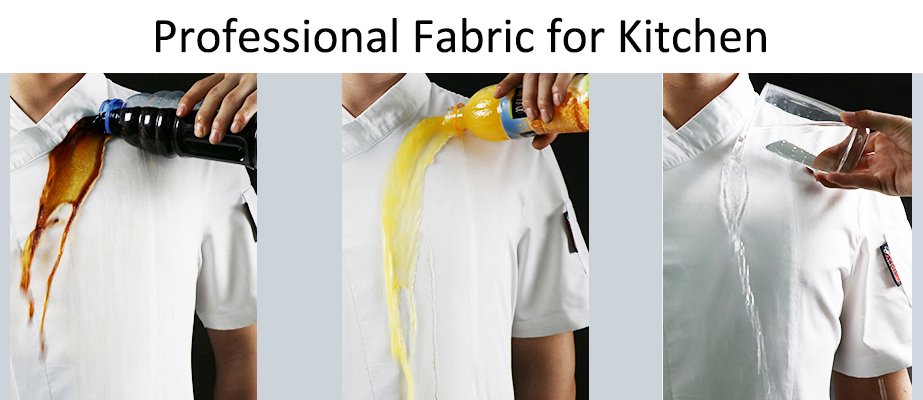
There are a wide range of fabrics, but mostly are cotton/polyester blend and polyester. The composition percentage has 65% polyester/35% cotton, 80% polyester/20% cotton, 60% polyester/40% cotton. The weight is between 190gsm-250 gsm.
90% of the chef uniforms are white color, white gives a clean and tidy impression. Of course, you can custom your own color, you can pick up the Pantone color number, or ask supplier to provide a color swatch to choose from.
Besides you can custom the fabric due to your requirement. The chef’s working environment is prone to water and oil, they are very easy to get dirty, and difficult to clean. Therefore, the fabric can be specially customized to have a waterproof and oil-proof function. But custom fabric with those functions require a MOQ, usually 10,000 Meters, delivery time for fabric around 20-30 days, so you need to have a good plan of the delivery time on production cycle.
More information about chef uniform fabric.
How to customize chef clothes?
The approximate style of chefs clothing are introduced above. How to start customizing chef clothes? We can custom chef hats, chef jackets, chef pants, kitchen shirts.
1 need to confirm about the design and style. There are usually three ways to get the style you need.
- send us the picture of the design and detail requirements.
- if you have a sample on hand, you can send the original sample.
- Choose from supplier catalog.
2 Choose the right fabric according to the style and requirements.
As mentioned before if there is a sample, we can source the same fabric, If not have the same, will provide other similar for reference. We provide free fabric sourcing service to all potential customers. If you have anything need to source please feel free to contact with us.
3 Free quotation
According to the style, fabric, accessories, workmanship and the quantity, we provide an initial quotation. Due to different clients request, We provide EXW(EX factory) Price, FOB price, CIF price, DDU and DDP price.
4 Customized samples
Factory will produce samples according to the specific requirements of the customers. Usually we will take photos before the samples are sent. Due to different factories, the sample usually will have sample charge, after mass production this sample charge will refund.
5 Mass production
After review the samples, If you have any comments on samples OR need to make changes. We will find the best solution based on customer requirements and our professional suggestions. After the final sample confirmed, the factory will move to production. The production time depending on the fabric and design, usually around 30 days.
6 Quality inspection
After the production is completed, before the goods send out, you can check the quality, there are many ways you can check the quality:
- Send small batch from the bulk goods for you to check.
- Ask the factory to take photos, the whole product and small details.
- Hire a third-party agency in China, which requires additional payment, usually in proportion to the number of orders
- Customer or customer agent/staff come to the factory to check.
7 Send goods.
After checking the quality, if there is no problem. Then will send the bulk goods. This is not the final step, if customers have issues on the products after delivery, the after sales team will handle that.
What a chef uniform is made up of
A chef uniform is not one garment — in a working kitchen it is usually five pieces, and each one does a specific job.
- The chef coat (also called a chef jacket, or chef’s whites) — the double-breasted jacket most people picture when they hear “chef”. It protects the torso from heat and splashes, and it is the piece that usually carries your logo or kitchen name.
- Chef trousers — cut loose and comfortable, usually in a cotton-rich twill, with an elasticated or drawstring waist and often a side pocket for a thermometer or a cloth.
- The apron — a waist or bib apron that protects the trousers from spills and gives you somewhere to wipe your hands.
- The hat — a toque for the head chef and a skull cap for the rest of the line; both are there to keep hair out of the food.
- The neckerchief — a small piece with a practical past: it absorbs sweat and can be soaked in cold water on a hot line.
If you are buying for one person you can start with the coat alone. If you are fitting out a whole team, buy the set — the pieces are designed to work together and to wash the same way. We break the coat shapes down in our guide to types of chef coats, and if you want to know where the classic white double-breasted jacket came from, see chef uniform history, meaning and standard.
How to choose a chef uniform supplier
Once you are ordering for a team rather than a single coat, the supplier matters more than the brand. Three questions decide whether a supplier is worth using.
- Can they repeat the order? A uniform is only a uniform if the tenth run matches the first. Ask how they keep the fabric, colour and trims consistent between orders.
- Can they match everything across sizes? Coats, trousers and aprons often come from different lines; a good supplier will confirm the colour matches across all of them, in every size you need.
- Can they handle branding? Embroidery and screen printing behave differently on different fabrics. Always ask for a sample of your logo on the actual fabric before you commit to a run.
The well-known retail brands are a useful reference point for style and price — we compare the main ones in our list of chef coat brands in the USA.
Colours and styles — and what they signal
Colour is not only decoration in a kitchen: it signals role and seniority. White remains the traditional choice because it shows stains and can be washed at high temperature; black is common in modern restaurants and hides oil marks; coloured piping is often used to tell the front of house from the line. The full breakdown, including what black and coloured coats usually mean, is in our guide to chef uniform colors and styles.
What to check before you buy
Before you place a bulk order, run through this checklist.
- Fabric and weight — a heavier twill holds its shape and resists splashes; a lighter poly-cotton is cooler and quicker to dry. Our chef uniform fabric guide compares the common options.
- Colour fastness — a coat that fades at the collar after a month was dyed cheaply. Ask how the colour holds up over repeated industrial washing.
- Shrinkage — pre-shrunk fabric keeps its size; untreated cotton can shrink a full size after the first wash.
- Wash and dry — kitchens wash often and hot. Confirm the garment can take a commercial laundry cycle without losing shape or trim.
- Sizing and fit — chefs work with their arms up and forward, so sleeve length and shoulder room matter more than a neat silhouette.
- Trims and finishing — buttons, poppers and zips should be heat-resistant, and the stitching should survive being pulled on and off every day.
Looking after chef uniforms
A uniform that is washed the right way lasts twice as long, which lowers the real cost per wear. High temperatures, the wrong detergent and tumble drying are the usual culprits behind faded colour and shrunken jackets — the full routine, including stain treatment, is in our guide to how to wash and care chef coats.
Buying chef uniforms in bulk, or with your logo
If you are outfitting a restaurant, a hotel kitchen or a catering team, brand shopping stops being the point. What matters is a supplier who can match the fabric, cut and trims you have chosen and repeat them across sizes and reorders. That is what we do at Heyday Dynasty: we supply custom chef uniforms and kitchen wear for restaurants, hotels and catering teams, and arrange fabric, sampling and production with partner makers. If you already have a design or a logo, we can work from it; if not, we can help you specify the fabric and cut first. See our custom uniforms service, read more about what we do, or send us your requirements.
Frequently asked questions
What is a chef’s coat called?
A chef’s coat is also called a chef jacket, or simply chef’s whites. The three names refer to the same double-breasted garment; “whites” is the traditional term, and “jacket” is the more common one in modern kitchens.
What colour should a chef uniform be?
There is no single answer. White is the traditional choice and still standard in many kitchens; black hides stains and suits modern restaurants; coloured piping or trim is often used to identify roles or teams. Pick the colour that fits your kitchen — just keep it consistent across the team.
How many chef uniforms does each person need?
Plan for at least three coats per person so one can be worn, one can be in the wash and one can be spare. For busy kitchens that wash on site every day, two coats can be enough; for teams that send laundry out, three to five is more realistic.
Should I buy in bulk or piece by piece?
For a team, bulk is almost always the better value: it locks in one fabric and colour across all sizes, keeps the logo consistent and is cheaper per piece. For a single replacement coat, piece by piece is fine.
The bottom line
A chef uniform is a working tool, not a costume. Get the pieces right, choose a fabric that survives your kitchen’s wash cycle and pick a supplier who can repeat the order — after that, colour, branding and style become easy. If you are sourcing for a team, send us your sizes and your logo and we will come back with options.
The End
As a cook lover, i think the most important is clean and safety, chef have a clean and tidy uniform they can have good mood and happy to make something really delicious.
